
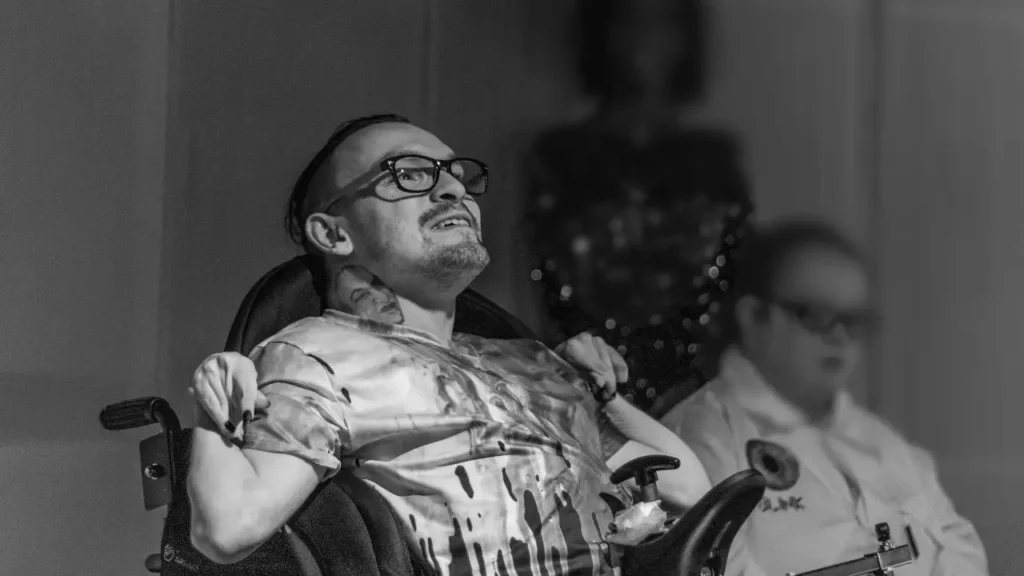
These blog posts were originally published on EGO’s website in 2019 by Kyle McCall-Wilson.
Find out more about “Blink” (2019) here.
Before the show
It’s so exciting being a cast member of Big EGO at the moment. As we are less then a month away from presenting our latest original production of “Blink”.
I’m Kyle and I’m here to give you a quick update on how we are progressing with undoubtedly one of EGO’s darkest productions. However, first I must confess that during my first blog about this upcoming show, I seemed to have misframed the show as a show focused heavily on disability. Perhaps to some extent, “Blink” did begin as a project rooted in our individual and collective experience as people who live with disabilities and other conditions. However, since that blog my perception of “Blink” has evolved along with the show itself.
Since November 2018, things have moved from a broad concept of the kind of message we wanted to portray to a fully fledged world, a world of those who have resources to be modified and live a socially accepted life and those who do not have the resources to live a modified and therefore socially accepted life. Sound familiar! I think “Blink” has the most potential to be found offensive and to be honest it probably should offend audiences. However I hope audiences are offended for the correct reasons, we have been very careful in deciding what we do and do not include and the purpose behind everything. Nothing in the world of “Blink” is there without reason, nothing is there for shock value and the most cutting remarks about disability and mental health have been greenlit by the cast.
Making this show has been very healing and surprisingly, the most emotionally difficult scene (which I won’t give away) has probably been the most healing. Blink is a really heavy show but it has been the most rewarding production that I have been a part of. The world that “Blink” is set in is a world I really don’t want to see become reality, however I feel that too much of our society already holds the same beliefs as those put forward by the presenter of the game show that is “Blink”, perhaps I include myself in that, I have a lot of internalized ableism and since working on “Blink” I’ve made a real effort to stop viewing disability and mental health issues as a problem to be solved, corrected or fixed, instead viewing those things as parts of humanity that we need to embrace and love. I see “Blink” as everything we need to avoid. I may be biased but I would call this show unmissable. I’ve avoided talking about the premise of the show simply because it has to be watched to be properly understood. However, I will say that this show is very immersive in terms of the technical and staging side of things and the intensity of the show is unrelenting. Personally, and I think everyone involved with “Blink” would agree, we hope you as an audience enjoy the show but we hope it stays with you.
After the show
Let me talk about “Blink” and how much of an impact working on that show had on me and why everyone involved felt so passionately about the world of “Blink” and our characters.
The way “Blink” was set out was that it was a show drenched in real ideas, real happenings and real life experiences. I find it strange and maybe a little bit frustrating that the audience only got to see the actual show and not the months of devising, sharing and bonding that made “Blink” possible.
“Blink” as a show was cold, harsh and brutal, though the making of “Blink” felt very warm, supportive and loving. It had to be that way for the show to be as honest as it was. For this show to work the way we wanted it to, we as a group felt it was so important that we demonstrate the darkest parts of what our lives have been like at times and the day to day assumptions that society makes about you if you don’t fit into the neurotypical box that society deems as normal. Society likes to think that because we have disabled people on the occasional TV programme and that because we have social media hashtags supposedly in support of better mental health, that’s enough, that we don’t face everyday discrimination as a result of how we were born, or even how we were made by a society that didn’t do enough to include us. So “Blink” was our chance to show that we still feel left out, that we are aware of how we are looked at and more importantly that how we are viewed is heavily influenced by the powerful & privileged decision makers who enforce policies that neglect any kind of empathy towards the vulnerable and marginalised in favour of “economic wellbeing”. This further stigmatizes those of us that need more support due to our health conditions as burdens to those who are more able to contribute to society in a traditional sense. “Blink” was an expression of what society could become if we continue to allow these ideas to persist unchecked and, worse still, if we continue to vote for people with these views into positions of power.
Sorry I got ranty didn’t I, but that’s why “Blink” meant and means so much to us. On a personal level I have held onto so much pain relating to how I’m viewed as a disabled person and also as a person who has a hidden mental health condition. People assume I’m depressed because I’m disabled. I’m not depressed because I am disabled, I’m depressed because of how society views me and my friends and how society has made us internalise that, so the mental health scene within the play was so important in showing that. It isn’t nice but those were real comments and sentiments. That scene was intense and I think we did for a moment question whether it was too long but quickly decided that the scene had to be that way because we as cast members have had a lifetime of that kind of thinking and misinformed cruelty, so maybe the audience should witness that discomfort and deal with it.
The making of “Blink” was many things but it was massively freeing and validating, when we opened up about our struggles in life during rehearsals through improvs or just discussions for show content, I felt like people cared and that my story mattered, there were no eye rolls and I didn’t feel like I was going to be told to be more positive or that it could be worse, the comments of most neurotypical people who “mean well” though somehow not well enough to listen and try to understand us. I mean I wasn’t surprised because EGO is EGO, one of the safest places I know, though I think I just got used to people in general ignoring, minimizing & able-splaining stories like mine. There was none of that and in the devising of “Blink”, it really was all love, hard work and fun. “Blink” really forced me to challenge how I view disability. Not just how I view my own disability, but the way I have viewed other types of disabilities and mental health conditions and how I may have viewed others in a derogatory way out of ignorance, arrogance and stupidity. I have no right to minimize anyone else’s’ humanity just because they have been born into different circumstances than mine, I have felt invalidated by so many people that felt they could do that simply because they viewed me as less human than them and I know how that feels. It sucks. And it sucks even more that I may have made others feel that way in the past. On a personal level, hearing the group discuss disability in depth a lot more, and feeling a new positive outlook or perhaps a more realistic view of myself as a disabled person, really jolted me into trying to change how I viewed myself and how I perceived how I can contribute to society. Perhaps being or trying to be a good person and a positive influence is at least as valuable to society than someone who is able to work and contribute in the traditional financial sense. All the things we were talking about in the making of “Blink” really kicked my butt in the best way possible. I wanted this show to change minds about mental health, disability and humanity. However, it wouldn’t have made sense for me to preach a message I didn’t feel or believe fully, so “Blink” was one of the things that pushed me into making some really important changes in my life for the betterment of my mental health and outlook on life.
Performing “Blink” was strange, shocking and surreal but also undoubtedly rewarding! “Blink” was the most confident I have felt as an actor and I think that’s because a lot of the time I wasn’t acting or at least it didn’t feel like I was. I’ve been in situations where people have mocked my speech and patronised me, so it isn’t hard for me to act. I’ve been in situations where I’ve witnessed people get hurt and have been powerless to do anything but scream and cry for it to stop. I didn’t have to reach far to get that. I’m painfully aware that many in society view me in ways described in the mental health round [a scene from the show]. I know that I’m assumed to be asexual and aromantic because of how people like me are portrayed in the media. All of the things said by Kimisha and Faduma’s characters were real. When Georgina and Corinne first read that part of the script to me none of it was surprising. Of course it hurts deeply knowing that people view me and people like me in those ways but it was very liberating for me to show the audience not only that I know these attitudes exist but to show how it affects and hurts me. Nobody should have to brave discrimination, the way disabled people are expected to due to society’s lack of empathy and unwillingness to understand. So to expose everything the way everybody’s character did during that scene felt amazing!
I don’t really know if I was expecting the audiences to react in any specific way, I know I’ve mentioned before that I was hoping they would be offended for the right reasons and that I was hoping Blink would stay with them. Judging by the tension immediately after the final scene every night and the feedback we got from the audiences, we gave them a show that stuck with them. The general mood seemed to be that people didn’t want to say that they “liked” it, because of course they enjoyed the show “Blink” but not the realities within the show. Some audience members felt uncomfortable clapping at the end as it didn’t feel appropriate. Personally, I think that type of reaction tells me that “Blink” wasn’t just any other show and that it had a real impact on people, which is backed up by the fact so many people told us that we needed to share “Blink” on a bigger stage and that more people had to see it.
In case you haven’t figured it out by now due to this stupidly lengthy and heavy-worded blog, I really loved being part of “Blink” and everything we managed to accomplish by being so open and honest. Blink has left a lasting impression on me in terms of me wanting to do more in relation to disability and mental health advocacy. I want to put the passion that “Blink” reignited in me and have my voice be heard. I think it goes without saying that I hope we get to revisit “Blink” again in the future. I’m so proud of everyone involved with “Blink” and really believe more people need to see “Blink”!